No surprises.
No exceptions.
The system that governs how every project is run.
Project controls are not an administrative function — they are the operating system of every Conroy project. They form part of our integrated ISO-aligned management systems (ISO 9001, ISO 45001, ISO 14001), ensuring that programme, cost, quality, safety, and environmental performance are managed to a single, consistent standard across every project we deliver.
The industries we serve — industrial, commercial, pharmaceutical, critical environments, and interiors — demand certainty on programme, cost, and quality from day one. Our controls framework makes performance visible in real time, gives clients full transparency, and ensures that every decision on site is traceable back to a defined process.
Four pillars.
One integrated system.
Programme, cost, quality, and change are managed as four interconnected disciplines — not four separate reporting streams. A decision in one affects the others. Our controls framework keeps all four aligned throughout the project lifecycle.
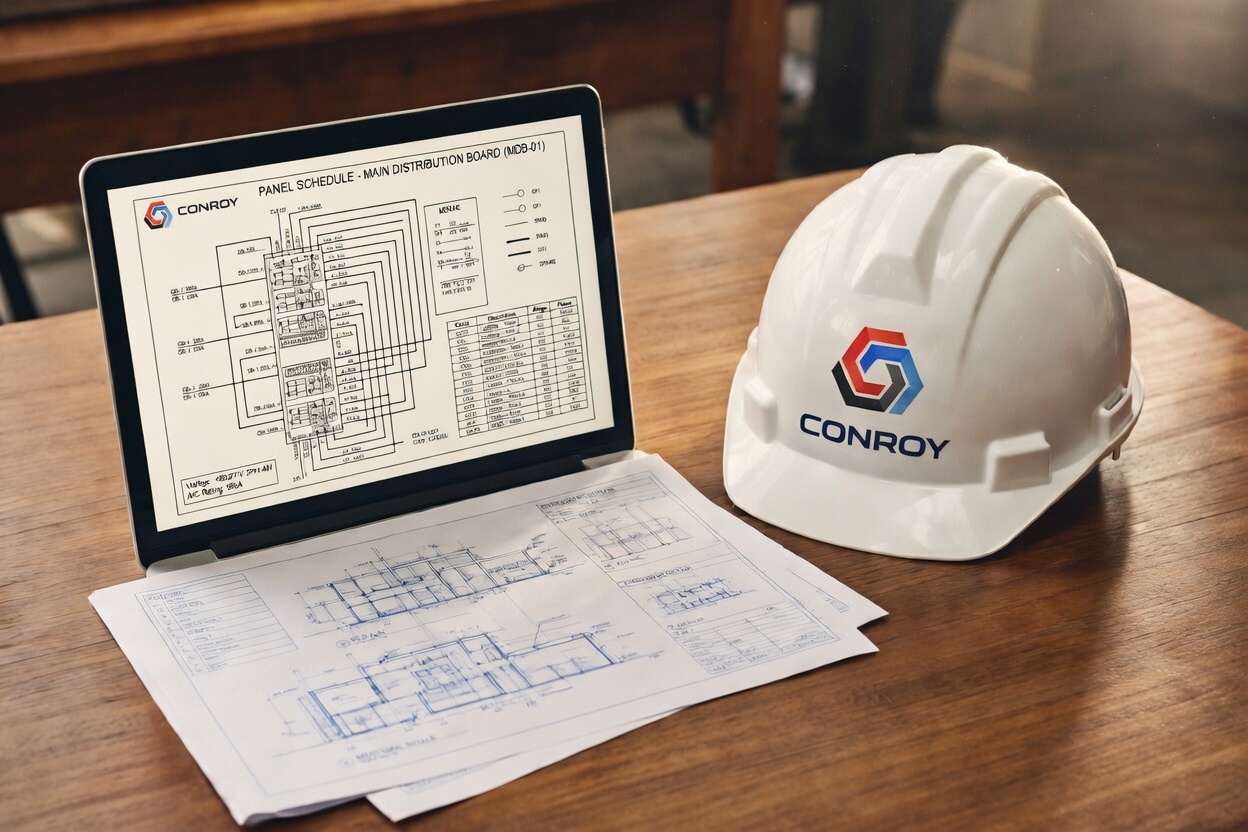
Reporting rhythm — what the client receives and when
A reporting schedule agreed at project start and maintained throughout. Conroy does not wait to be asked for information — it is issued on a fixed cycle. If something significant changes between reporting periods, the client is told immediately — not at the next scheduled report.
All programme reporting is produced using our dedicated PM software. Reports are issued in a consistent format agreed with the client, with a clear executive summary at the front that does not require the reader to work through the detail to understand project status.
Full cost visibility from award to close
On every project, scope changes, site conditions, and design developments create movement in cost. Our job is to ensure that movement is tracked, agreed, and communicated in real time — so the client always has an accurate picture of the current financial position.
Our monthly cost report is structured to give the client a complete financial picture in a single document. It is not a summary — every figure is traceable to the underlying contract, variation, or subcontract cost.
Quality records that survive the project
The quality record produced during construction becomes part of the building's operational history. In regulated environments it is a regulatory requirement. In all environments it is what the client relies upon when something needs to be maintained, extended, or handed over again in the future.
- Quality management framework for the specific project
- Subcontractor quality obligations — stated and enforced
- Document control — issue register maintained throughout
- Substructure, frame, envelope, MEP, fit-out — each with own ITP
- Hold points defined — work cannot proceed without sign-off
- Completed ITPs retained in the quality file for handover
- O&M manuals — co-ordinated and reviewed before issue
- As-built drawings and BIM model — updated and verified
- Warranties and guarantees — collated and assigned
- Commissioning and test records — complete set
- Health & safety file — PSCS obligations met in full
Project controls by sector
Each sector we serve has distinct project controls requirements. The framework is consistent — the application is industry-specific.
- Fast-track programme management — steel, envelope, and slab on parallel sequences
- MHE and racking interface tracked against operational fit-out milestones
- Floor flatness and levelness (FM2/FL) testing scheduled into ITP
- Dock leveller, cold store, and automated system commissioning co-ordinated with end-user vendors
- Sectional completion and phased handover controls where facilities are occupied in stages
- Construction activity managed around live operational environments and continuity windows
- Critical power and cooling commissioning records structured for Tier classification evidence
- Energisation and system testing documented with contemporaneous records
- Permit-to-work systems for work adjacent to live infrastructure
- Clean protocol enforcement during data hall fit-out and commissioning phases
- Construction quality records structured to feed directly into IQ/OQ/PQ documentation
- Change control traceable to the design basis — every deviation assessed for GMP impact
- Non-conformance reports assessed against regulatory implications (HPRA / MHRA)
- Cleanroom construction protocols — environmental monitoring, material control, access logs
- Commissioning and validation documentation produced as a project output, not a retrofit
- Lease milestone and occupier move-in dates built into the programme from day one
- Facade, MEP, and fit-out package procurement tracked against programme-critical dates
- BREEAM and nZEB compliance evidence compiled progressively throughout the build
- Landlord works and occupier fit-out interface co-ordinated with clear demarcation
- Stage certification, building control, and planning condition compliance maintained throughout
What you can expect from Conroy's project controls — on every project
These are the operating standards applied to every project we deliver, regardless of size, sector, or contract form. They define how we work with our clients.
A project controls framework you can rely on from day one
Whether project controls is a specific priority for your next project or simply something you expect as standard — we'd welcome a conversation.